
High School Meetup Notes
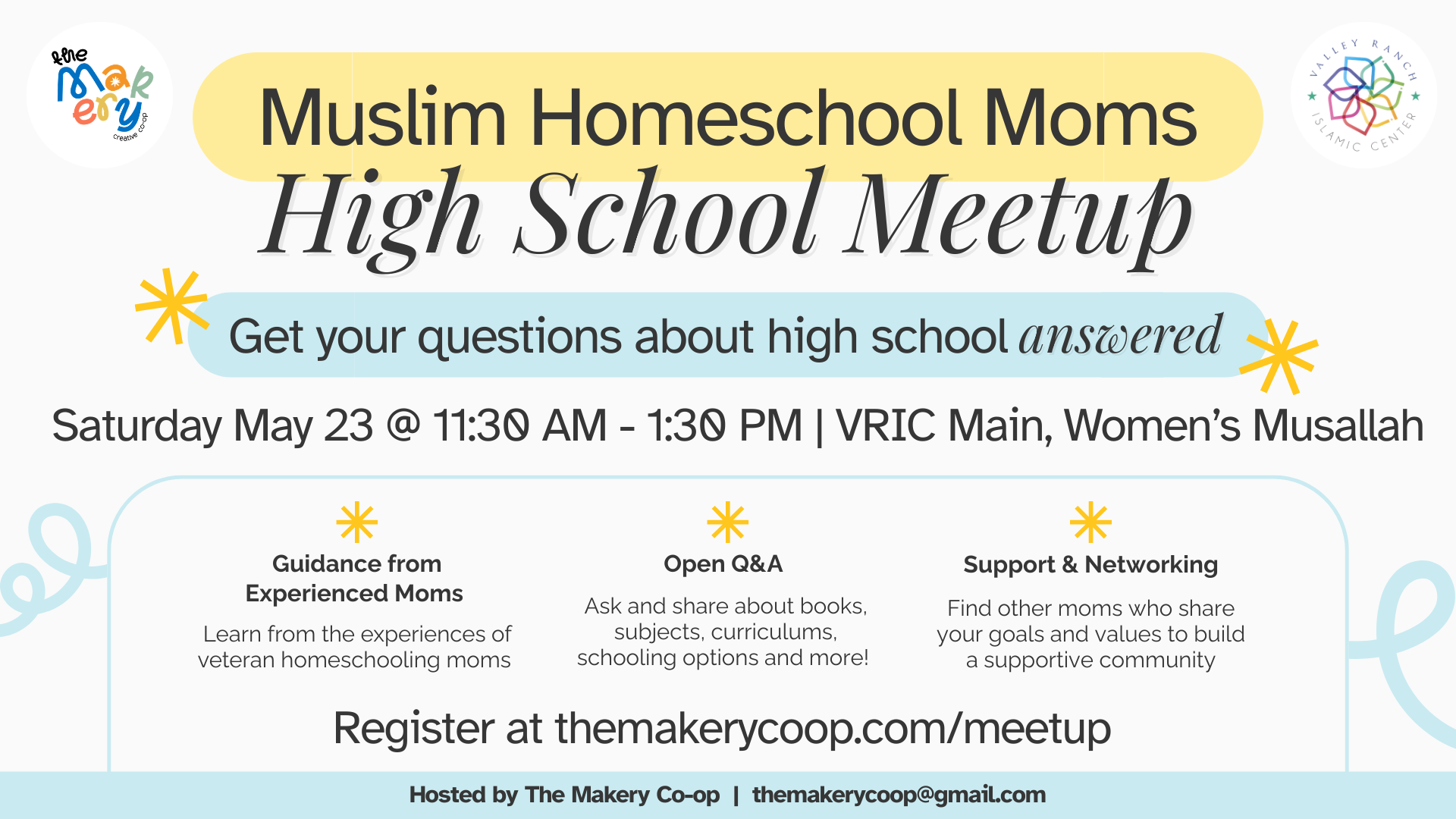
In May 2026, The Makery hosted a session on how to approach homeschooling your high school student. We had a panel of 3 seasoned homeschool moms who shared their experiences and advice. Below is the audio from the session, the speakers' presentations and a summary of what was discussed.
1. Panel Context & Participant Demographics
The Origin: The meeting was organized by a local mother navigating the upcoming transition of her oldest child into 9th grade, prompting her to bring a network of local mothers together to share collective wisdom on navigating high school.
The Community Platform: The speakers primarily represent Muslim families in the Dallas-Fort Worth area (specifically Dallas County and Richardson, Texas) who extensively coordinate via community WhatsApp groups.
The Panel Experience: The participating mothers range from those just beginning the high school transition to seasoned homeschool veterans. Their families include children who have already graduated college, completed Hifz, entered local universities like UTD, or taken gap years to figure out their next steps.
2. State Law Realities: Texas vs. California
California Standards: For families transitioning from other states, the rules vary drastically. In California, many homeschoolers “exam out” of high school early via the CHSPE (California High School Proficiency Exam). While it doesn’t yield a traditional diploma, it legally finishes high school requirements, allowing advanced students to graduate as early as age 15.5.
The Texas Private School Classification: In Texas, homeschools are legally classified as completely unregulated private schools.
State Mandates: There is no state registration, no attendance reporting, and no standardized testing required. Parents are legally mandated only to teach 5 core subjects: reading, spelling, grammar, math, and good citizenship—interpreted however the parents see fit.
The Written Requirement: Texas law dictates that the curriculum must be written (using books or written digital materials); a curriculum cannot be purely audio-based.
Parental Authority: Ultimately, the parent acts as the principal and sole administrator of the homeschool, creating the transcript, assigning the grades, and deciding exactly when to issue a legally binding, notarized diploma.
3. Transcripts, GPAs, and University Validation
The Power of the Principal: Texas parents are encouraged to actively optimize transcripts. Because parents assign the grades, they can weight transcripts for college-level classes, which easily pushes a student’s GPA well above a 4.0 (up to a 5.0 on a weighted scale).
The Missing Rank Metric: Texas homeschoolers cannot provide an official class rank. Because many local scholarships are automatically tied to high school rank, homeschool students must rely heavily on high SAT/ACT scores or excellent AP test results to validate their capabilities to highly competitive universities like UT Austin.
The Seamless Transfer Route: For parents who want to bypass freshman admissions scrutiny and rigorous transcript validation entirely, the consensus was to send kids to community college for 1–2 years post-high school graduation. Transferring from one college to another bypasses the need for freshman admissions high school transcripts altogether.
Legitimizing Islamic Studies: Mothers strongly advised against omitting religious studies from the official transcript. Quran classes can be framed as “Music/Qirat Electives” (focusing on phonetics and pronunciation), Sira can be labeled “Islamic History 101,” and Islamic art counts simply as “Art.”
4. Technical Navigation of Dual Enrollment (Dallas College)
The Cost Benefit: Dual enrollment is completely free for Dallas County residents. Parents only pay for textbooks or electronic resources, which usually totals around $60 per credit (though some noted they were never billed due to digital fee waivers).
The 8-Week Semester Hack: Dallas College offers an accelerated 8-week track alongside standard 16-week courses. For example, in an 8-week English 1301 course, students might only be required to write 3 essays instead of 5, allowing them to earn a full year of high school credit in half the time.
The Quality Trade-Off: Multiple mothers noted that Texas community college courses are surprisingly low-rigor, often feeling like “casual busy work” compared to systems in California or New York. One mom shared an example of a history professor giving out exam questions and answers beforehand, resulting in an “easy 100.”
The Shifting Rules Scramble: A shared frustration is that Dallas College changes its logistical rules, course requirements, and registration hoops almost every semester. Parents must constantly cross-reference updates rather than relying on what worked for older siblings.
The TSI Exam Loophole: To start dual enrollment, students traditionally must pass the TSI placement exam. However, recent rule changes allow the reading and math portions to be waived if the student successfully completes an English and specific math class (like college algebra) within their first five courses.
The “Core Complete” Strategy: If a student’s goal is merely to check off the state’s baseline higher-education requirements cheaply, parents can steer them away from high-level math and science tracks (which require passing the math portion of the TSI). Students can instead load up on basic sociology, psychology, and introductory humanities courses to earn safe college credits without math-induced stress.
Professor Scrutiny: The mothers emphasized that a student’s experience hinges entirely on the instructor. Students must strictly rely on sites like Rate My Professor and peer networks to avoid vindictive graders or exceptionally poor lecturers, effectively choosing the professor over the course material itself.
The Age and Social Warning: Entering a physical community college campus at 14 or 15 exposes kids to adults and highly sensitive adult conversations (such as LGBTQ topics). Mothers advised that while online classes mitigate this, in-person classes offer better learning, meaning parents must pre-assess their child’s emotional maturity and teach them how to navigate adult spaces.
5. AP (Advanced Placement) Classes as an Alternative
The Rigor Benefit: Because dual credit can lack depth, mothers use AP classes for subjects their kids love (like English or Human Geography). AP is recognized as far more rigorous and better at preventing the “university shock” where dual-enrollment students fall flat on their faces in higher-level classes.
The Bureaucratic Hurdles: Managing AP testing requires jumping through hoops with local high school counselors for exam registration, as homeschool parents cannot administer the official tests themselves.
The AP Training Loophole: Parents can technically teach AP courses directly from home using standard prep books. However, complex AP tracks (like AP Seminar or AP Research) require instructors to undergo a rigorous two-week training program with the College Board. One speaker shared a workaround where a local public school teacher graciously “took the homeschool students under her wing” to officially administer and submit their AP test materials.
6. The “Toolkit” Philosophy of Success
The mothers urged each other to look past the immigrant-parent stereotype of forcing every child to become a doctor or an engineer. Instead, they design high school around a specific “Toolkit” of lifelong skills:
Identity and Confidence: Giving kids a deep understanding of Islamic history so they have unwavering confidence when entering spaces where they are the minority.
Communication Articulation: Prioritizing reading, writing, public speaking, and journalism, which the mothers feel are highly underestimated but crucial fields for Muslims.
Extracurricular Tracking: Parents often discredit their kids’ everyday achievements. The speakers noted that running a girl’s magazine, writing for a teen newspaper, volunteering at the masjid, or even working for a grandparent’s business all legally count as leadership, internships, or volunteer hours.
Vocational Viability: Not every child is built for a 4-year university. Dallas College offers certificate programs (like X-ray tech or respiratory tech) that get young adults straight into high-paying job markets earlier.
7. Re-framing Hifz (Quran Memorization) in High School
A significant portion of the conversation focused on a mother whose 9th-grade son chose to pursue Hifz but was progressing slowly under a very relaxed teacher.
The Critique of Modern Hifz Schools: The mothers critiqued the local “copy-and-paste” Hifz school model, arguing that forcing a child to sit for hours straight without utilizing different parts of the brain mimics childcare rather than effective learning.
The Catch-Up Potential: Parents shouldn’t panic if a child pauses heavy academics for 2–3 years to focus on the Quran. Homeschooled kids possess the unique ability to catch up on high school subjects rapidly once Hifz is complete, as the discipline of memorization permanently expands their learning capacity.
The Compromise: Even during full-time Hifz, a student must maintain basic “muscle” subjects: daily math and English (which can easily be paired with social studies).
8. Mentorship, Co-ops, and Local Recommendations
The Power of the Group Vibe: The speakers heavily emphasized that co-ops function as an emotional and social buffer for teens. It is crucial for a 14-year-old’s development to struggle with deadlines, navigate conflicts with teachers they might not like, and experience external grading before they are thrown into adult environments.
Peer-Led Classrooms: The community benefits from unique peer-to-peer modeling. For instance, older teenagers within the community who have specialized passions are actively leading educational tracks for younger students (such as conducting an 8th-grade AP literature group or running localized magazines and newspapers).
Specific Local Plugs:
Sister Saad (Misbah Co-op): Highly recommended for structured high school prep, science labs, and select AP course offerings.
Teacher Shiba: A community-favorite English teacher from New York who teaches through local co-ops, praised for her rigorous approach (and humorous tendency to pass a slight Staten Island accent onto the local Texas kids).
9. Final Inspirational Takeaways
Pick a Name of Allah: Dedicate each homeschool year to a specific name of Allah (e.g., Al-Khaliq, Ar-Rahman) to anchor your mindset and alleviate “mom guilt” and FOMO when comparing your kids to public school peers.
Prioritize Friendship: High school is a developmental hot mess where voices crack and bodies change. Use these four years to build a foundational friendship. One mother noted that because of this closeness, her adult sons (ages 23 and 24) still follow her around to ask for advice on marriage and career moves—a dynamic rare in traditional schooling.
Have Fun: Don’t turn high school into a boring corporate checklist. Bake brownies in the middle of the night, learn an unconventional language, pick up rock climbing, and memorize the Quran alongside your kids. Treat homeschooling as a luxury of mercy.